Hiển thị các bài đăng có nhãn Self-Portraits. Hiển thị tất cả bài đăng

Self Portraits of Mars Rovers


A few days ago, NASA released this beautiful panoramic image of the Martian Landscape. While majestic by itself, the view is enhanced by the presence of the newest Mars Rover, Curiosity, in the middle of the picture, on top of the hill overlooking the whole planet. The photograph shows just how far NASA has reached in terms of being able to beam back images of robots on other planets, but this picture isn't the first self picture of a robot on Mars. These are some of the self-portraits of all Mars rovers to date.


To start with, the image above shows the Mars Pathfinder which landed on Mars in 1997. The mosaic is centered around the fixed lander called the Carl Sagan Memorial Station, and prominently shows the solar cells which powered the station. While technically not a rover, the Pathfinder package did contain a mobile robot named Sojourner which can be seen in the upper left-hand corner near Yogi Rock.

The Sojourner rover lasted only 83 sols (Earth days), but the Pathfinder mission was considered a success in that it was the first endeavor of its kind since NASA launched the Viking Program in 1976. Aside from the scientific findings of the planet's surface, the program proved that the airbag-method of landing was feasible. The small robot Sojourner also showed success in being able to maneuver on a foreign planet.


The above self photograph was taken by the rover Spirit (more formally known as Mars Exploration Rover - A) in 2007, midway through its life on Mars. The rover  is one of two identical Mars rovers, the other being Opportunity. The rover was launched from Earth in 2003 and it arrived on Mars in early 2004.

The rover's panoramic camera shows the heavy dust build up on its solar panels, which greatly affected its ability to charge its batteries (this earlier self-portrait shows what the rover would look like with relatively clean panels). While strong winds would sometimes clean away the dust build up, this tendency to gather debris on itself would have a detrimental impact on the rover's life. The robot became stuck in soft soil in 2009, but continued to perform in a stationary position. Spirit sent its last communication in 2010, and NASA formally ceased communications attempts in 2011, after 2,208 successful working sols.


This last, shadowy portrait shows the still active Mars Exploration Rover B, also known as Opportunity, the twin brother of the Spirit rover. While the two robots landed on Mars at about the same time in 2004 (albeit in different locations), only Opportunity has continued to perform consistently, surpassing its original 90-sol mission. The rover celebrated it's 3,000 sol in the middle of last year, and it's still being used to explore the Meridiani Planum somewhere around Mars' equator.

On the other hand, the header photograph shows the youngest of the Martian rovers, Curiosity. This robot is about the size of a sedan, a mammoth compared to the earlier sojourner which was only the size of a milk crate. Curiosity's mission is to investigate the climate and geology of Mars, and help determine whether the planet's environment is conducive to microbial life.

For more information about these self portraits of all Mars rovers, check out the NASA's JPL Mars Exploration Rover homepage and mission page. For more photographs from beyond Earth, check out the Outer Space category of this blog.

Matuschka: The Beauty of Damage


Photography has always had the power to affect the viewer, for better or worst. Whether it's an ad image designed to increase a company's sales or a blurry image exposing torture and abuse, a powerful photograph cannot be ignored. Artist Matuschka made the same impact over a decade ago, raising breast cancer awareness in a way that couldn't be ignored with her self-portrait entitled "Beauty of Damage".

Matuschka was born Joanne Matuschka in New Jersey. She lost both her parents at a young age, which made her to run away from home. Fortunately, she came under the guidance of a foster mother who recognized her artistic talent and encouraged the growth of her creativity. Since her start as a professional artist, Matuschka has worked with different mediums including photography, and has exhibited her artworks around the world. She has also combined her artistic endeavors with her social activism.

In 1991, Matuschka underwent a mastectomy (a surgical operation involving one or both breasts). Instead of hiding her scars, she took the opportunity to shift her art and activism to spreading more awareness about breast cancer. She shifted the focus of her nude self-portraits to prominently feature the absence of her right breast.

Her self-portrait collection focusing on breast cancer slowly grew in number and was named Beauty of Damage, a series designed to show the beauty of the woman despite physical afflictions. One image in particular would later gain worldwide acclaim due to its graphic nature and the medium in which it was published. It shows the artist leaning against a bare wall looking towards the light. She wears a white dress that covers her body except for a large open patch revealing her mastectomy scar on her right side.

When the image was published as the cover of The New York Times in August 1993, it provoked responses from both the extreme left and right. Some cancer survivors felt that they were being unnecessarily  exposed while others saw it as the next step towards gaining more acceptance in public. The cover photograph was so striking that The New York Times received more mail than any other time in its history up to that point.

While the photographed garnered numerous awards, she slowly began to focus on other subjects. Her last photographic self-portrait was made in 1994 because in her own words,"...I don't want to spend the rest of my life in cancer land". She has since moved on to other projects and mediums, but she continues to work with the spirit of her tireless activism.

This is Matuschka's website. The Beauty of Damage website has more information on the cancer survivor artist and the picture of her bare right chest. This New York Times article (PDF) was the feature article of that August 1993 and provides great insight into how breast cancer was viewed back then.

Sleeve Face: The Portrait within A Portrait


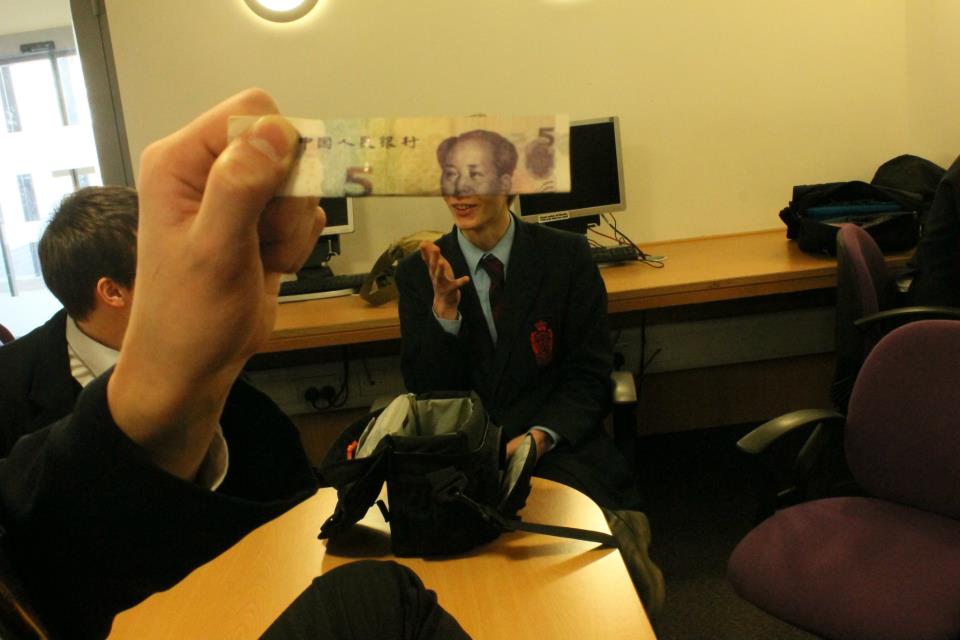
The money shot or banknote face featured previously was a nice diversion from the more serious portraits of this blog. If you tried to make your own money shot at home, you probably encountered some difficulty because of the small size of the bill. Not so with Sleevefaces or LP Portraits. If you happen to have any old vinyl record covers, simply put them up to your face, pose appropriately, and click the shutter. You now have yourself a sleeveface, the instant portrait within a portrait.


A sleeveface, otherwise known as a vinyl portrait or LP portrait, is a hybrid photographic portrait wherein the subject holds up a vinyl cover to his face, with the cover design's outline matching that of the subject's body. The resulting photograph should give the impression that the sleeve's face is really the subject's face. Hence the name sleeveface.

The current fad began around 2007 when a sleeveface was uploaded to Facebook, but it's not unreasonable to believe that the idea to put up a vinyl cover to one's face and take a picture must have existed long before the Internet.


The beauty of vinyl record covers as alternate real-life faces is that they're large enough to carry life-sized images on them. All you need to do is put your face up to a cover and take a picture. This in contrast to moneyfaces wherein you have to carefully adjust the distance between the banknote, your face and the camera. With the right lighting and angle, sleevefaces can create a satisfyingly good illusion.


The style of the past decades in which vinyl records were still popular also presents a unique twist to creating sleevefaces. Many cover design can be over-the-top, but even the more somber ones can present photographic challenges. Remember, the cover only takes up the area of your face, so you're free to pose the rest of the set as you will. In most cases, what's happening outside of the cover is what's actually most interesting.


Looking to find more portraits within portraits? There are a number of websites that cater to sleeve faces, the most popular by far is SleeveFace.com. There's also SleeveFaced.com and SleeveMyFace.com. Don't forget about the Facebook Group and Flickr Group. Finally, if you find yourself online, flip through the pages of the book Sleeveface: Be the Vinyl which is 192 pages of album cover fun.

The Money Shot: The Half-Bill Face


There's playing with money, and there's really playing with money. You may have spotted a few of these half-money, half face pictures over the last few weeks. All that's needed is half a banknote held up to your face in front of your webcam. The moment you click the shutter, you've just created your money shot.

Creating new faces from half bills isn't anything new, but it recently got a boost over the Internet thanks to a Reddit thread created a month ago about the topic. The picture above was the first such image shared on the site and pretty soon other members began posting their own half-face, half-money creations. Check out some of the better money faces below.


The original Reddit thread on these half-money faces is here. For more money shots, check out The 99% Behind the Money tumblr over here and Show me the Money Face over here.

Nazee Abbassi: Self-Portraits of the East and West


Yes, you're seeing double, but that's because that's what the photographer intended. With the week's theme on self-portraits, it would be a nice touch to end it with a more personal look at the method and process. In this case, photographer Nazee Abbassi shows her take on her own identity as she photographs herself for a self-study, in effect giving viewers a glimpse of her self-portraits of the East and West.


Nazee Abbassi became internet famous a few weeks ago due to her thought-provoking pictures and is now somewhat known as the Iranian girl with self-portraits of her Iranian and American selves.

She explains that, "This project is a series of self portraits exploring who I am, both as an American and as an Iranian, through photographs. It has always been a struggle for me to explain myself, who I truly am, and how I should or shouldn’t act in given situations. I feel that maybe these photographs will answer some questions. Questions people might have, or even questions I have for myself as a person who has lived with two cultures her whole life. Sometimes I feel confused, proud, and sometimes even awkward about how to simply deal with the differences of the two parts that make me."


While there are obvious differences in her Iranian and American personas, the collection succeeds in bringing out some subtle distinctions apart from her attire. Take for example the picture of Abbassi in her car; her Iranian self sits in the back seat while her American self is in the driver's seat. In another image, the American character toasts with what looks like champagne while the Iranian character prefers soda. These small but powerful differences make these photographs into real portraits.


Contrary to what you might think at first, the differences presented in the images don't break-up her identity but instead makes them clearer for the viewer. While portrait photography strives to capture the real essence of the subject, even the best portraits can't contain the subject's whole self, only an image of the person at the split-second the shutter is pressed.

In Abbassi's case, her different personas captured in one frame helps viewers see her true self.


Nazee Abbassi's self-portraits of her East and West can be found on her blog. The full set of her self-studies are here. And while on the topic of Iranian women, check out this fanciful look at some Iranian teenage girls' fashion choices as photographed by Shirin Aliabadi over here.

Martin Liebscher: Self-Portraits of Me, Myself and I


Have you ever wanted to duplicate yourself in pictures you've taken of yourself? With the advent of digital photography, it's become relatively easy to Photoshop yourself into the same image as many times as you like with the clone stamp or the simple cut-and-paste tools. The only question is, "How many duplicates is enough in one image?" Artist and photographer Martin Liebscher probably hasn't asked that question as he has perfected the art of duplicating himself in the thousands in his imposing collection of self-portraits entitled “Familien Bilder”.


Martin Liebscher started his self-portrait series in 1991 and over the years the number of doppelgangers in his images has grown from around a dozen, to over fifty, to the thousands in his more impressive works. He calls his images Familien Bilder or Family Pictures as he employs other Liebschers (actually duplicates of himself) to fill up the canvas that is his photograph, erasing any other passers-by caught in the frame.


Liebscher mentions that his self-portraits are made in order to question one's identity both individually and in a group. In his photographs, he is the only person playing every role, yet his individuality disappears amid the hundreds of otherselves in the frame.

That or he's just looking for an excuse to clone himself into every image he's taken.


Creating each of his panoramic images can take anywhere from two days to six months, depending on the scale and location. The photographer also has to act the part of the subject, busily fiddling a violin or moving construction material when the scene calls for it. In some images, his facial expression has to be just right in order to convey the illusion of actually being and living in the space.

Going through his collection, you get the feeling that Liebscher has over the years set his goal of multiplying his doubles towards bigger and bigger dimensions, and greater and greater stages. Either that or he's gone completely out of control with his duplications. You decide.


Interested in creating your own self-portraits of me, myself and I? Go over to Martin Liebscher's website over here. His  Familien Bilder or Family Pictures is over here. His photographs have been published in the books Martin Liebscher: Imprint, Martin Liebscher: A Man With Opportunities and XL-Photography: Art Collection Neue Borse.

Cindy Sherman: Self-Portraits of Others


Dressing up as someone or something else has been a popular Halloween tradition ever since people found it fun just to do so. There is no apparent reason or rationale behind most people's costumes, which makes sense given it's only done one night every year. One person however has found that dressing up can conjure up different accounts from different people at any time of the year. In these images, photographer and artist Cindy Sherman redefines dressing up by presenting self-portraits of other people through herself.


The name Cindy Sherman along with the header image may ring a bell with devoted readers of this blog as the "self-portrait" was featured a few months ago as the most expensive photograph ever sold, fetching a staggering $3.89 million at a Christie's auction. It would be unfair, however, to judge Sherman's work based on the price and image of one photograph. It would be hard to judge her work even after going through most of her photographs, as there's some ambiguity as to who, what and why Sherman photographs these women in the first place.

That's because all of the women posing here are Sherman herself being different people through the same medium. These self-portraits aren't self-portraits after all, but rather commentaries on cultural stereotypes of women in popular media and society as a whole.


Sherman's first came to the public's attention when she presented her Untitled Film Stills (1977-80). Here, she photographs herself in black-and-white in different costumes and locations which are reminiscent of Hollywood films of the golden age. Sherman purposely left them all untitled so that the viewers would be able to come up with stories of their own. Even with the images alone however, it's easy to cast these women in stereotypical roles of the devoted housewife, the loyal secretary, the sultry romantic interest or some other generic plot device.

She continued to act out roles for her photographs, at one time reenacting nobles and aristocrats in old paintings in her History portraits, at another donning on the colorful and sometimes scary makeup of clowns, becoming both anonymous and recognized in her artworks.


On a very basic level, Sherman is simply acting out characters from her imagination, on a deeper level she discards her own identity to portray that of another for a split-second, and on an even deeper level, she tears down the very definition of photography that what is in captured by the camera is objective and truthful.

Or this could all be just Sherman's way of fulfilling her childhood wishes of dressing up for Halloween every day of the year.


Cindy Sherman doesn't have an official website, but you can find a few dozen examples of her artworks over at artnet.com. There's also a few more over at the Art History Archive. For books covering her self-portraits of others, there's Cindy Sherman, Cindy Sherman: The Complete Untitled Film Stills and Cindy Sherman: Working Girl (Decade Series 2005).