Hiển thị các bài đăng có nhãn Photographers. Hiển thị tất cả bài đăng

Alexander Gronsky: Less Than One


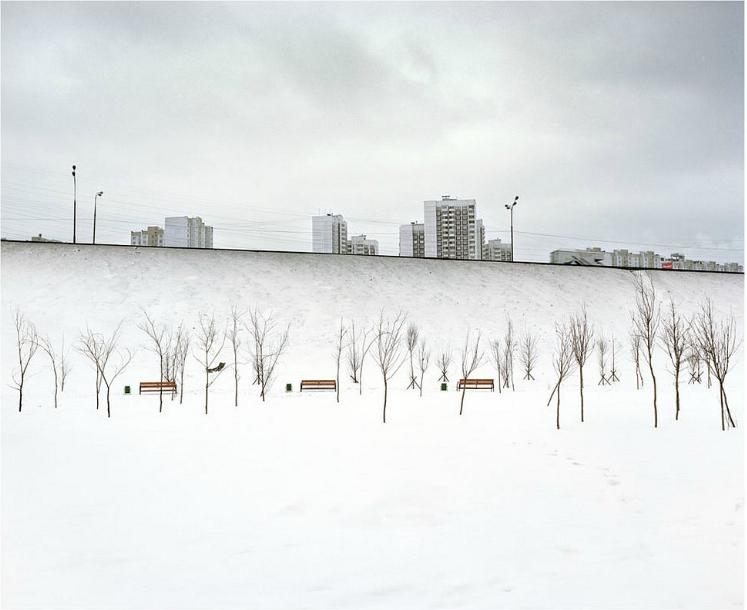
Winter still dominates much of the northern hemisphere, so it's only fitting to feature more photographs on this subject. This special season only heightens the feeling of loneliness and the perception of endlessness with its foggy textures and white-gray hues, but what happens when these feelings and perceptions are presented in an area with less than one person per square kilometer? Alexander Gronksy tries to answer that question in his series, "Less Than One".


Alexander Gronsky has already been previously featured here for his series "The Edge", photographs that explore the meeting points of the urban and rural, civilization and nature, and everything that involves these boundaries. He focuses most of his energies into exploring old concepts and presenting them in a new format, especially with regards to subjects in Russia.

In his series, "Less than 1", Gronsky points his camera at the same subjects, but this time with the aim of documenting the areas in Russia with a population density of only one person per square kilometer. The photographer traveled to the countries outlying areas to see what life is like in such a sparse environment. The results might look like of his other projects, but the element of his purpose adds an additional dimension the photographs in this series.


The photos in this series were also taken during the making of Gronksy's other work, "The Edge". This previous project done in the cold months of winter on the outskirts of Moscow heightened the sense of loneliness and isolation of his subjects as well as provide a more minimalist view for the entire series. Gronksy also revisited several of these sites, as he took three years to complete this work beginning in 2006.

While many of these photographs lack a human subject, there is still a strong feeling of people, whether it's the sense of their awaited arrival, or the dread of their imminent departure. Scenes like a colorful playground without any children, a group of townspeople seeing off the lone ferry at their port, or simply the trash littered around the ground all point to a civilization that seems to be waiting for spring in order to start living again.


Even with the strong human element in his images, Gronsky sees himself more as a landscape photographer. This frame of mind only helps to emphasis the environment in his photographs as they add a strong foundation for his visual stories. Thus, Gronksy has been described as a photographer who belongs to the new generation of graphic documentary photographers.

Gronksy's series on these places in Russia have a strong sense of nostalgia, as if the old days of the Soviet Empire still reign, yet they also hint at a more hopeful future, when spring will come to wash away the gloom. For this beautiful collection showing what the world is like in a place with a population of only less than one, Gronsky received the Foam Paul Huf Award for 2010.


Alexander Gronsky's website is here. His previous series on "The Edge" can be found here. His published works can be found in the book, Contact Sheet 166: Pastoral. For more features on landscape photographers, check out these previous posts.

Alexander Gronsky: The Edge Of The World


The changing seasons have long provided inspiration for artists since man began creating art. Winter, while being one of the more somber seasons, provides plenty of material for storytellers. The themes of death, rebirth, beginning and end all play into this season, and its easy to see why. Photographer and artist Alexander Gronsky captures what the edge of the world looks like in his project, "The Edge".


Alexander Gronsky is a professional photographer who has worked for different advertising agencies and publications. Over the last few years, he has devoted his photography to his personal projects, leaning towards documenting the unique landscape and people of his adoptive home of Russia.

In his "Mountains & Waters" project, Gronsky looks at booming Chinese cities and how the landscape has changed with urban development. In his "Less Than One" series, the photographer travels to the most desolate places in Russia where the population density is less than one person per square kilometer. In his "Pastoral", Gronsky looks at the intersection of the urban and rural, areas that fit neither concrete definition. For this work,  Gronsky won the 3rd Prize in the Daily Life category of the World Press Photo 2012, one of the many prizes he has accrued to his name over the last decade.


In his project entitled, "The Edge", Gronsky explored the concepts of boundaries in reality, presented in an abstract manner. The photographer captured different scenes all around Moscow city, exploring the meeting points between the urban and the wild, industrial and residential, and all other points of convergence. Similar to Daniel Kukla's Mirror Landscapes, Gronsky presents how diverse a landscape can be, this time with added element of people.

In addition to the subject matter in his photographs, Gronsky heightens the feeling of isolation through the use of the nature of winter. The photographer had previously photographed the area during the warmer months of the year, but shooting these landscapes in winter gives the scene a "blank canvas" look ready to be filled by the subjects of Moscow. In the same way as Marek Samojeden uses the snow as neutral space, Gronsky  only needs a few subjects to give color to his minimalist photo artworks.


Gronsky also presents a different boundary present in all photographs: the photographic frame itself. These images only exist within the edges of the photographic paper, creating another boundary between reality and abstract.

While Gronsky's artistic statement about his photographs might get overly philosophical, there's no denying that he's managed to captured a magical world in the white blanket of winter. His project is aptly entitled, "The Edge", but his images are more about intersections: industrial and rural, old year and new year, winter and spring, and so on. It's wonderful to see how even the seeming edge of the world, while being overwhelmingly muted, can still still be vibrant with urban life.


This is Alexander Gronsky's website, with more images of the edge of the world and his other projects there. His portfolio, Contact Sheet 166: Pastoral, can be purchased here. For another view of edge landscapes, check out Daniel Kukla's Mirror Landscapes. For a different take on winter, have a look at Marek Samojeden's winter time in Poland.

Robert Capa: 20th Century War Photographer


Images and videos of war have become more commonplace in today's digital age compared to the situation years ago. It's now possible for ordinary citizens armed with a camera phone to shoot an armed conflict scene, upload it to Facebook or Youtube, and have thousands of views the next day. Decades ago, only a select few has the technology and willpower to do that. Here is the story of 20th century war photographer Robert Capa.


Robert Capa was born Endre Friedmann in 1913 in Hungary. He left the country because of his activist stand against the government and settled in Berlin, finding himself working with photography and art. The rising Nazi threat forced him to move again, this time to France where he changed his name to the more American sounding name "Robert Capa" in order to market his photographs better.

Capa then traveled to Spain at the start of the Spanish Civil War, and it was here that he made a name for himself as a war photographer. His famous "Falling Soldier" photograph became an instant classic, although its authenticity would be questioned later on. Capa also traveled to China to document the Japanese invasion there. The photographer was slowly building a name for himself as a photojournalist, but his greatest achievement would happen later on during the Allied liberation of France starting with D-Day.


Some of Capa's most famous war time pictures include his Magnificent Eleven, a series of black-and-white photos showing the American forces landing at Omaha Beach on D-Day. Capa was in one of the landing crafts together with one of the invading platoons. He shot 106 frames of films that day, and was in London the next day to have his film developed.

The story goes that the darkroom technician assigned to process the film was so excited to see the resulting pictures that he applied too much heat to the film drying process, accidentally melting almost all of the frames. Only 11 images survived, and these precious 11 were among the first pictures of D-Day to be published and seen by the American public.


Capa continued to travel after the war was over, and in 1947, he co-founded Magnum Photos, one of the most prestigious photographic cooperatives in the world alongside other imminent photographers such as Henri Cartier-Bresson.

While Capa is considered to be one of the greatest photojournalists of the 20th century, some of his work's  integrity have been questioned, especially with his most famous photo, the "Falling Soldier" showing a Spanish Republican loyalist soldier falling to the ground as he's hit by a bullet (the header image above). When it was first published in Life magazine, it was described as the exact moment of the soldier's death, and quickly became one of the most famous war photographs of its generation.

Recent studies strongly suggest, however, that the scene was staged at a different location far away from the purported battlefield. These studies also invalidate the rest of the photos Capa's took around this time. Despite these recent findings though, Robert Capa's legacy has allowed newer generations of photojournalists to aspire to get closer to the action, because in his words, "If your picture isn't good enough, you're not close enough".


Magnum Photos has more images by Robert Capa. His 20th century war photographs can be found in Robert Capa: The Definitive Collection, Robert Capa at Work: This is War, Blood And Champagne: The Life And Times Of Robert Capa. For a 21st century look at war photography, check out James Nachtwey.

Man Ray: Photography As Art


There's no doubt that photography grounds itself in being able to take factual scenes with objectivity. Most people might argue that editorial photography really began with the advent of Photoshop and its related programs, but almost 100 years ago, one pioneering artist was blurring the lines between photography and art, even advocating for photography as art. This is the ground breaking work of Man Ray. (WARNING: THIS POST CONTAINS NUDITY).


Man Ray was born Emmanuel Radnitzky in 1890, but due to the growing anti-semitesm in the Philadelphia neighborhood he grew up in, his parents changed their surname to Ray. His friends called him Manny, which he shortened to Man, which eventually led to his now famous name, Man Ray.

Ray displayed great enthusiasm for the visual arts as a child, learning how to draft in primary school and supplementing his education with frequent visits to local museums. After graduating, he decided to pursue a career as an artist, despite being offered a scholarship in architecture. Ray studied at a couple of art schools before dropping out and teaching himself the rest of the way. Slowly, he worked towards become a professional painter, and he soon started receiving commissions as an artist and illustrator.


As an artist, Ray leaned towards the popular cubist movement of that time, looking for inspiration in prominent painters such as Marcel Duchamp who would later become one of his closest friends and frequent sitters. Ray continued to develop in his paintings, but it was only in 1918 that he started to work on photography seriously. Shortly after, he began associating himself with the Dada movement, producing even more avant-garde paintings and scultptures.

The experimental works he did with his paintings also translated into his photography, with many of his images reflecting classical techniques combined with unorthodox photographic processes. Ray invented the Rayograph, more popularly known as the Photogram, which involved placing objects on light-sensitive paper and exposing it directly to light, creating shadows and silhouettes. Ray also developed the Solarisation Technique which creates light areas in a photograph to appear dark or vice versa (some of the photographs in this post use this technique).


Ray became a highly successful portrait photographer, with many of his artist friends agreeing to sit for hum. Not content with the still medium, Ray later went on into film, involving himself with a series of avante-garde movies in the 1920s. In his later life, the artist continued to work with traditional paint, photography and film, but always seeking to find new ideas, both in terms of subject and execution.

Photography for Ray wasn't so much as medium to simply document what was in front of him. Rather, it was a way for him to to explore his dreams and ideas in a novel manner. Indeed, his most famous photographs aren't those that came straight from the wet plate, but those that were heavily edited or "photoshopped" using the earliest instruments of photographic editing. For Ray, the ultimate goal of photography in his own words, was to "... produce a photograph that would not look like a photograph".


The Man Ray Trust is the official trust site for the late artist. The Man Ray Photo website has extensive collections showing how the photographer made photography as art. Some of the many books on the artist include Man Ray, Photographs by Man Ray: 105 Works, 1920-1934, and Man Ray Photographs.

Mario Testino: Hollywood Royalty


Young photographers looking to break into the print industry today will have to face an uphill climb. Not only  are there more photography enthusiasts encouraged by cheaper DSLR prices, there are also established professionals who have made a name for themselves photographing Hollywood royalty. Even those that have spent 20 or 30 years in the business don't seem to be retiring anytime soon. If there's one photographer that has been there and done that, it's Mario Testino.


Mario Testino was not popular in his childhood years in Peru. Tagging along with his father to New York on business trips, the young Testino developed a taste for fashion. However, he was ridiculed back home for his fashion sense, so he decided to move to the UK when he got older. It was only in London some 20 years later that he decided to pick up a camera and start photographing people.

Testino worked as a theater photographer's assistant, as well as a waiter. As his list of contacts grew, he began attracting the attention of amateur models by selling portrait portfolios, complete with hair and makeup sessions before the photo shoot. He began getting commissions from different magazines, but it would be a little while longer in the late 1990s that he would get his big break in the industry.


Testino's popularity took off in 1997 when he was chosen to take portraits of Diana, Princess of Wales for Vanity Fair. The photographer has stated on multiple occasions that Diana was his favorite model of all time. Unfortunately, the candid portraits of Princess Diana would be her last occasion for a formal sitting as she died 12 weeks later. Despite the tragedy, Testino's images of the late Princess proved to be a hit, and he has since been commissioned to portraits for other members of the British Royal Family. In 2010, Testino engagement photos of Prince William and Kate Middleton were the first official images of the couple together.

Testino is credited for having cultivated a whole new generation of supermodels, often times preferring lesser known models to those already established when the photographer came into the scene. The photographer was one of the first to encourage Kate Moss with whom he has collaborated on multiple occasions. Testino also fought for Gisele Bündchen when many publications passed her over. Today, the two are the world's top earning fashion models.


Almost 30 years after his first photographic portraits, Testino continues to travel and work for different magazines. His schedule is so hectic that Testino is never in the same country for more than a few weeks, which has earned him the title of being the busiest fashion photographer of modern times.

Still, being the busiest commercial photographer has its advantages, from photographing the cover of Vanity Fair's Hollywood Issue to working with fashion giants such as Dolce & Gabbana and Burberry, to photographing the Royal Couple's engagement picture. And Testino doesn't seem to be showing any signs of stopping any time soon.


This is Mario Testino's website. For more inside views of Hollywood royalty, check out Mario Testino: Private View (Limited Edition), Diana: Princess of Wales and Kate Moss by Mario Testino.

Patrick Demarchalier: In Vogue


Over the years, consumers have come to expect a certain quality when it comes to magazine covers and editorial prints. Whether it's in the pages of Vogue or Vanity Fair, people expect to see subjects lit by soft light against stark grey backdrops or gorgeous mansions. Creating photographs like these becomes a challenge when the photographer has to jump from portraiture to fashion to fine art. One photographer who makes the whole business look easy is Patrick Demarchalier.


Patrick Demarchalier is one of the fashion industry's foremost photographers. He began taking photographs at the age of 17 when he received a Kodak camera from his step father. He later moved to Paris and became a photographer's assistant, learning the tricks of the trade while on the set of magazine photo shoots. Demarchalier also worked in a photography lab, developing his negatives himself. He eventually climbed his way into becoming an assistant for a French Vogue magazine photographer before becoming one himself.

Demarchalier's first photographs for French Vogue caught the attention of one Condé Naste editor who brought him to New York in the early 1970s. He first worked on Glamour Magazine before being tasked to work on Vogue USA. Despite not knowing a word of English at that time, he soon became one of the most sought-after photographers in the fashion industry


Demarchalier's early years in New York helped him develop as a photographer as he was able to work with other notable photographers such as Henri Cartier-Bresson. He also got to work with the most famous fashion designers and supermodels of the 1970s. It was around this time the modern look and style of the fashion magazine were established, and Demarchalier played a big role in this format.

In 1993, Demarchilier shot Janet Jackson naked from the waist up save for a pair of hands covering her breasts. The photograph was used for a Rolling Stone magazine cover, and became one of Jackson's album covers. In 2009, the photographer appeared in the fashion documentary "The September Issue", a behind the scenes look into one of the fashion industry's most anticipated monthly magazine. In 2010, Demarchalier was one of the featured photographers in America's Next Top Model (Cycle 15).


Over the years, Demarchalier has jumped from one project to the next, but his heart remains with fashion. While his photographs might share the same look, he says that it's because of the lack of innovation in the fashion industry. He says, "Things change. Then, after a while, they come back. So things get longer and longer and longer. And then they get shorter and shorter and shorter. And at the fashion shows, people say, 'Ah! Fantastique!' - but things were like that 10 years ago; they go around. Only amazing designers think of the truly new."

Still, his photography has helped establish the classic look of the fashion magazine industry. In an industry that's bursting with new and talented photographers, fashion designers, set designers, make-up artists, and models, it's amazing how Demarchalier continues to stay relevant and innovative.


For more images by Patrick Demarchalier's images of Vanity Fair, Vogue and W nagazine, check out his website here. For printed editions, there are Patrick Demarchelier, Dior Couture and Patrick Demarchelier: Forms.