Hiển thị các bài đăng có nhãn Alexander Gronsky. Hiển thị tất cả bài đăng

Alexander Gronsky: Less Than One


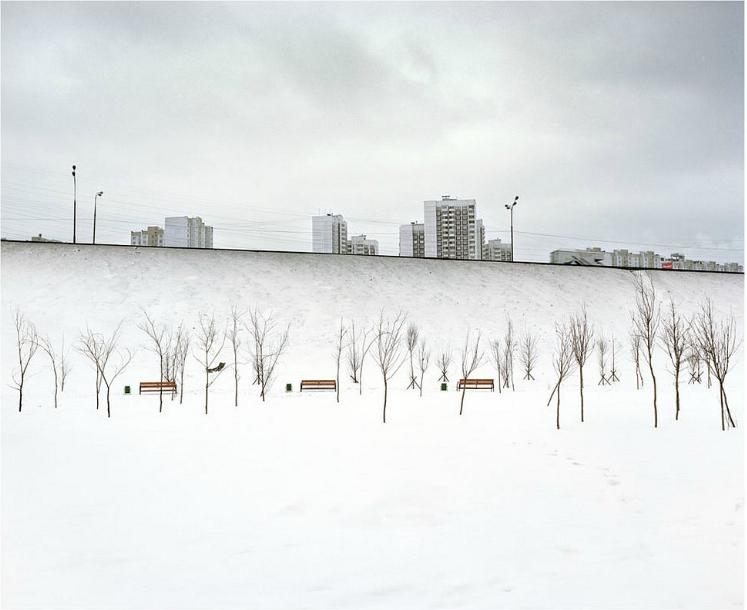
Winter still dominates much of the northern hemisphere, so it's only fitting to feature more photographs on this subject. This special season only heightens the feeling of loneliness and the perception of endlessness with its foggy textures and white-gray hues, but what happens when these feelings and perceptions are presented in an area with less than one person per square kilometer? Alexander Gronksy tries to answer that question in his series, "Less Than One".


Alexander Gronsky has already been previously featured here for his series "The Edge", photographs that explore the meeting points of the urban and rural, civilization and nature, and everything that involves these boundaries. He focuses most of his energies into exploring old concepts and presenting them in a new format, especially with regards to subjects in Russia.

In his series, "Less than 1", Gronsky points his camera at the same subjects, but this time with the aim of documenting the areas in Russia with a population density of only one person per square kilometer. The photographer traveled to the countries outlying areas to see what life is like in such a sparse environment. The results might look like of his other projects, but the element of his purpose adds an additional dimension the photographs in this series.


The photos in this series were also taken during the making of Gronksy's other work, "The Edge". This previous project done in the cold months of winter on the outskirts of Moscow heightened the sense of loneliness and isolation of his subjects as well as provide a more minimalist view for the entire series. Gronksy also revisited several of these sites, as he took three years to complete this work beginning in 2006.

While many of these photographs lack a human subject, there is still a strong feeling of people, whether it's the sense of their awaited arrival, or the dread of their imminent departure. Scenes like a colorful playground without any children, a group of townspeople seeing off the lone ferry at their port, or simply the trash littered around the ground all point to a civilization that seems to be waiting for spring in order to start living again.


Even with the strong human element in his images, Gronsky sees himself more as a landscape photographer. This frame of mind only helps to emphasis the environment in his photographs as they add a strong foundation for his visual stories. Thus, Gronksy has been described as a photographer who belongs to the new generation of graphic documentary photographers.

Gronksy's series on these places in Russia have a strong sense of nostalgia, as if the old days of the Soviet Empire still reign, yet they also hint at a more hopeful future, when spring will come to wash away the gloom. For this beautiful collection showing what the world is like in a place with a population of only less than one, Gronsky received the Foam Paul Huf Award for 2010.


Alexander Gronsky's website is here. His previous series on "The Edge" can be found here. His published works can be found in the book, Contact Sheet 166: Pastoral. For more features on landscape photographers, check out these previous posts.

Alexander Gronsky: The Edge Of The World


The changing seasons have long provided inspiration for artists since man began creating art. Winter, while being one of the more somber seasons, provides plenty of material for storytellers. The themes of death, rebirth, beginning and end all play into this season, and its easy to see why. Photographer and artist Alexander Gronsky captures what the edge of the world looks like in his project, "The Edge".


Alexander Gronsky is a professional photographer who has worked for different advertising agencies and publications. Over the last few years, he has devoted his photography to his personal projects, leaning towards documenting the unique landscape and people of his adoptive home of Russia.

In his "Mountains & Waters" project, Gronsky looks at booming Chinese cities and how the landscape has changed with urban development. In his "Less Than One" series, the photographer travels to the most desolate places in Russia where the population density is less than one person per square kilometer. In his "Pastoral", Gronsky looks at the intersection of the urban and rural, areas that fit neither concrete definition. For this work,  Gronsky won the 3rd Prize in the Daily Life category of the World Press Photo 2012, one of the many prizes he has accrued to his name over the last decade.


In his project entitled, "The Edge", Gronsky explored the concepts of boundaries in reality, presented in an abstract manner. The photographer captured different scenes all around Moscow city, exploring the meeting points between the urban and the wild, industrial and residential, and all other points of convergence. Similar to Daniel Kukla's Mirror Landscapes, Gronsky presents how diverse a landscape can be, this time with added element of people.

In addition to the subject matter in his photographs, Gronsky heightens the feeling of isolation through the use of the nature of winter. The photographer had previously photographed the area during the warmer months of the year, but shooting these landscapes in winter gives the scene a "blank canvas" look ready to be filled by the subjects of Moscow. In the same way as Marek Samojeden uses the snow as neutral space, Gronsky  only needs a few subjects to give color to his minimalist photo artworks.


Gronsky also presents a different boundary present in all photographs: the photographic frame itself. These images only exist within the edges of the photographic paper, creating another boundary between reality and abstract.

While Gronsky's artistic statement about his photographs might get overly philosophical, there's no denying that he's managed to captured a magical world in the white blanket of winter. His project is aptly entitled, "The Edge", but his images are more about intersections: industrial and rural, old year and new year, winter and spring, and so on. It's wonderful to see how even the seeming edge of the world, while being overwhelmingly muted, can still still be vibrant with urban life.


This is Alexander Gronsky's website, with more images of the edge of the world and his other projects there. His portfolio, Contact Sheet 166: Pastoral, can be purchased here. For another view of edge landscapes, check out Daniel Kukla's Mirror Landscapes. For a different take on winter, have a look at Marek Samojeden's winter time in Poland.