Hiển thị các bài đăng có nhãn Mars. Hiển thị tất cả bài đăng

Self Portraits of Mars Rovers


A few days ago, NASA released this beautiful panoramic image of the Martian Landscape. While majestic by itself, the view is enhanced by the presence of the newest Mars Rover, Curiosity, in the middle of the picture, on top of the hill overlooking the whole planet. The photograph shows just how far NASA has reached in terms of being able to beam back images of robots on other planets, but this picture isn't the first self picture of a robot on Mars. These are some of the self-portraits of all Mars rovers to date.


To start with, the image above shows the Mars Pathfinder which landed on Mars in 1997. The mosaic is centered around the fixed lander called the Carl Sagan Memorial Station, and prominently shows the solar cells which powered the station. While technically not a rover, the Pathfinder package did contain a mobile robot named Sojourner which can be seen in the upper left-hand corner near Yogi Rock.

The Sojourner rover lasted only 83 sols (Earth days), but the Pathfinder mission was considered a success in that it was the first endeavor of its kind since NASA launched the Viking Program in 1976. Aside from the scientific findings of the planet's surface, the program proved that the airbag-method of landing was feasible. The small robot Sojourner also showed success in being able to maneuver on a foreign planet.


The above self photograph was taken by the rover Spirit (more formally known as Mars Exploration Rover - A) in 2007, midway through its life on Mars. The rover  is one of two identical Mars rovers, the other being Opportunity. The rover was launched from Earth in 2003 and it arrived on Mars in early 2004.

The rover's panoramic camera shows the heavy dust build up on its solar panels, which greatly affected its ability to charge its batteries (this earlier self-portrait shows what the rover would look like with relatively clean panels). While strong winds would sometimes clean away the dust build up, this tendency to gather debris on itself would have a detrimental impact on the rover's life. The robot became stuck in soft soil in 2009, but continued to perform in a stationary position. Spirit sent its last communication in 2010, and NASA formally ceased communications attempts in 2011, after 2,208 successful working sols.


This last, shadowy portrait shows the still active Mars Exploration Rover B, also known as Opportunity, the twin brother of the Spirit rover. While the two robots landed on Mars at about the same time in 2004 (albeit in different locations), only Opportunity has continued to perform consistently, surpassing its original 90-sol mission. The rover celebrated it's 3,000 sol in the middle of last year, and it's still being used to explore the Meridiani Planum somewhere around Mars' equator.

On the other hand, the header photograph shows the youngest of the Martian rovers, Curiosity. This robot is about the size of a sedan, a mammoth compared to the earlier sojourner which was only the size of a milk crate. Curiosity's mission is to investigate the climate and geology of Mars, and help determine whether the planet's environment is conducive to microbial life.

For more information about these self portraits of all Mars rovers, check out the NASA's JPL Mars Exploration Rover homepage and mission page. For more photographs from beyond Earth, check out the Outer Space category of this blog.

What Is It Like To Live On Mars?


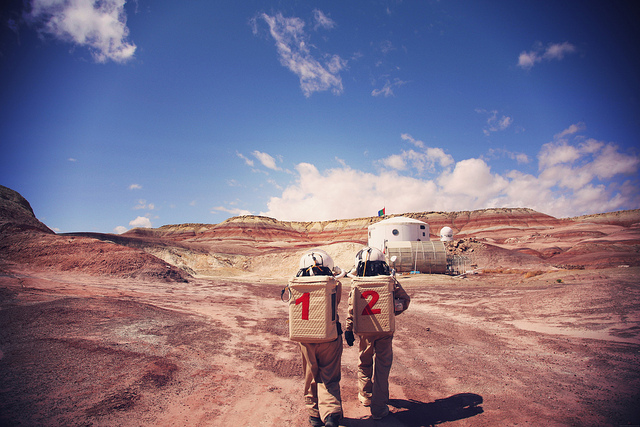
What's it like to live on the planet Mars? The number of books and movies about the red planet are in the hundreds, but most of those are in the realm of fiction. The idea, too, of colonizing Mars isn't novel, but that endeavor might not happen for another few dozen or even hundred years. Thankfully, a group of forward-thinking people are preparing for that momentous enterprise, and one of those people, Angeliki Kapoglou, has captured in images that group's first steps.


Angeliki Kapoglou is a Materials Engineer with a list of accomplishments too numerous (and technical) to mention. Around the end of March of this year, she spent two weeks with five other equally accomplished specialists and professionals at the Mars Desert Research Station near Hanksville, Utah. To the benefit of photo enthusiasts (and Mars lovers alike), she kept a visual diary of her immersion there.

The Mars Research Desert Station (MDRS) is a project of the Mars Society, a group whose lofty goal is to explore and settle the planet Mars through grounded means beginning with experiments such as the MDRS.


The MDRS is one of two simulations being conducted by the society; the other is the Flashline Mars Arctic Research Station in the Canadian Arctic, where the environment resembles the Martian planet very well. The MDRS in Utah is slightly less analogous to the red planet, but it is much easier to reach and maintain.

In this case, Kapoglou was part of MDRS Crew 102. During the 15-day simulation, the team did a variety of experiments including in-habitation and extra vehicular activities (EVAs), equipment repairs, Spirulina (food source) development, as well as daily observations on how the human individuals and the group as whole fared in the operation. Although two weeks isn't nearly enough to provide the training necessary for a Martian landing, it still provides the public (and the scientific community) a general idea of what it's like to live in a barren but beautiful outerland.


The crew's experience can be read over here, but if you're not one for technical jargon, Kapoglou's fantastical images provide an engrossing substitute. Kapoglou's simple photography along with the instagram-like filters makes the whole experience look like something out of a movie. It doesn't hurt that the Utah badlands provide a breathtaking backdrop to the whole experiment.

With photographs as fun as these, it's easy to forget that this is a serious experiment with the intention of getting humans to Mars eventually. These early simulations and experiments just might be the first small steps towards man leaping onto Mars.


Interested in living the Martian experience? Check out both the Mars Society and MDRS websites. If these images don't give you the full impression of what it's like to live on Mars, head on over to Angeliki Kapoglou's Flickr set featuring the Mars Desert Research Station (Utah) over here. If you're wondering whether the Martian landscape looks anything like the Utah badlands, check out the previous post. Finally, if you've ever wondered what the view from Mars might look like, check out this post here.

The Face Of Mars


On July 25, 1976, Viking Orbiter 1 captured an image that would spark the imagination of millions around the world and reignite the debate of life on Mars and in other worlds outside of earth. The image, dubbed F035A72, showed the Cydonia region of Mars, but it would be infamously known as the image of the face on Mars.

In the upper center portion of the whole image, viewers can see the eerie outline of what appears to be a humanoid face: the shallow cups of the eyes, a pointed peak of a nose that meets the outlines of the lips, and the general symmetry that could only be described as a human face, or at least an alien monument to that effect.

While the picture attracted the attention of the general public, most NASA scientists knew that it was nothing more than a mesa on Mars. Over a dozen years later, better camera equipment showed that this was the case. Images from the Mars Global Surveyor in 2001, the European Space Agency's Mars Express in 2006 and the Mars Reconnaissance Orbiter using its HiRISE camera in 2007 (the image below) all show that the original face was nothing more than a combination of sunlight hitting the aspect at a particular angle, the camera technology at that time, and most people's tendency to find faces in everyday objects ( a phenomenon known as Pareidolia).


While the myth of the face on Mars has been debunked, that doesn't conclusively mean that extraterrestrial life doesn't exist. With the Mars Science Laboratory set to launch by the end of the year, once can still dream of finding life in space. Who knows, the definitive proof for life on Mars might be found by then.

The original image containing the face on mars (image number TF035A72) can be found on NASA's JPL website. Head on over here to read a detailed account of the discovery and myth, and here and here for even more detailed analysis on the Martian geological feature.

Earth, the Final Frontier


The last few weeks have seen many  astronomy related anniversaries and planned upcoming missions, so it's only fitting that this blog should also feature a series of photographs about space. With the recent celebration of Earth Day, the first post in this series should somehow tie all of these themes together with an amazing image. The above photograph of Earth from Mars is such an image.

This gray-scale picture is remarkable in that it is the first ever photograph of Earth from another planet. If you are having trouble finding the pale dot that is the Earth, have a look at the image below.

The credit to this photograph goes to NASA's Mars rover Spirit which has been peacefully hibernating for more than a year now. The image is actually a mosaic taken by the robot's panoramic camera, giving observers a view of the Martian Horizon with Earth visible. The contrast has been adjusted to make it easier for human eyes to make out that little dot that represents planet Earth.

There are many other fantastic images of Earth and space taken from other robots and satellites that could have been featured today (and probably will be featured on this blog in the future), but this one was chosen for many reasons. Firstly, this view from Mars' surface seems strangely familiar and alien at the same time; if not for the description in this post, it could easily be mistaken for a photo of space taken from Earth.

Secondly, that same view could one day be seen by future generations of humans without the aid of any camera or robot, but with their very own eyes. Lastly, it's a comforting thought that of all the photos of space that is available online, it's still an image of Earth, however faint it may be, that is still one of the most inspiring.

Speaking of space, this post would be found wanting if didn't also feature the Habitable Zones of the Internet, a very informative and entertaining site run by fellow blogger Astronomy Pirate. Mr. Pirate will no doubt correct any mistakes regarding the information presented in this post as well as any future posts about space.

The original photo mosaic of can be found here, hosted on NASA's Jet Propulsion Laboratory website. The Earth from Mars image with the text can be found here, which is part of the NASA Goddard Space Flight Center Flickr photostream.