Hiển thị các bài đăng có nhãn Websites and Blogs. Hiển thị tất cả bài đăng

The PDN Photo of the Day Feature


The previous feature on photographer Tim Flach's action portrait wasn't just picked out of the blue. It's actually one of the beautiful images presented on one of the best photo blogs today: the PDN Photo of the Day blog.

The PDN Photo of the Day website is a blog that features daily photographs and photographic collections from among the most talented photojournalists and artists around the world. It is run by Photo District News magazine, and welcomes user-submitted images, provided they live up to the standards of the blog.

The PDN Photo of the Day is worth checking out for those who have time on their hands. The previous Tim Flach feature from PDN's Spring Loaded feature. The above image is taken from Jorg Badura’s Portraits of Paddlers.

The US Department of State's Guide to Passport and Visa Photography


Anyone who's ever gone to school, applied for a job or voted in governmental elections will have had his identification photo taken. The look of the ID picture is so fundamental that a beginner can have his taken without any instructions. However, in case of passports and visas, the State Department isn't taking any chances by making instructions plain and obvious to avoid mistakes. The US Department of State's Guide to Passport and Visa ID Photography.


The US Department of State has done a great job providing its citizens with a helpful travel website through http://travel.state.gov/. There, readers can learn about safety and emergency tips for traveling abroad, and go through the application and renewal process for Passports and Visas.

The website provides a list of photograph requirements for the Visa or Passport ID photo, as well as a section for Frequently Asked Questions. The usual ID photo instructions are detailed there; the image should be in color, should be taken against a plain white background, etc. To make these instructions as clear as possible, the State Department even provides a few photo examples of these instructions.

Unfortunately, a few of these tips seem so painfully obvious that they appear comical. Still, it stands to reason that the State Department must receive several applications with these incorrect photos, otherwise they wouldn't have made this photo guide in the first place.


The full Visa and Passport photo guide can be found on the The Bureau of Consular Affairs / US Department of State website. You might also like this tongue-in-cheek photography guide for beginners.

Scott Schuman: Light Catcher


Scot Schuman of The Sartorialist blog continues to inspire photographers and fashion enthusiasts all over the world with his simple yet powerful images of ordinary people with extraordinary fashion sense walking the streets of New York, Milan, London, and other metropolitan cities. Now the photographer cum "Light Catcher" will be releasing his new book, "Closer" on August 29 and is sure to entertain and inspire countless others for the very same reasons.


Over the years, Schuman's Sartorialist blog has grown from being a simple site with pretty pictures of pretty people to a dedicate website showcasing the best sartorialists of each city he visits. In particular, Schuman has found a way to harmoniously unite the subject with the city background, all of which are painted with just the right kind of natural light.

Be it hard light...


Or soft light...


Or filtered light...


Go over to Scott Schuman's The Sartorialist blog for more "light catching" moments. Check out the previous Reel Foto feature here, and his video mini-documentary over here. You can pre-order his new book, "Closer" either as a Limited Edition, or as a Paperback Edition, which comes in Male Cover or Female Cover variants. His first book, The Sartorialist is still in publication. Schuman is also holding a contest to give away a free copy of his new book over on his website.

The Glory that was Kodachrome: Old Color Photographs from the Shorpy Archive


In today's digital age, there doesn't seem to be any limitations when it comes to color photography. It's become so easy to alter the color and look of your images with tools like Instagram, but over 50 years ago when commercial color photography was just in its infancy, some of the most beautiful images were made without any kind of special filters. That was the glory of Kodachrome, and now these old color photographs are easily viewable courtesy of Shorpy.com.


These outstanding color photographs of the World War II era were made possible through Kodachrome, a color film introduced to the public by Kodak in 1935. Kodachrome was one of the most popular films used for high quality portraiture and photojournalism up until a few years ago, when production was halted due to the dwindling demand of film photography (in favor of digital photography).

The images here were taken under the supervision of the Farm Security Administration - Office of War Information which took a visual census of the US from the time of the Great Depression up to the War, and included some notable photographers such as Dorothea Lange and Gordon Parks.  Many of these images are also from the same collection used for the Bound for Glory exhibition featured on this blog a few months ago.


Shorpy.com is a photo blog dedicated to high quality old photographs from the beginnings of photography in the 1850s to the nostalgic golden age of the 1950s. The site is named in honor of Shorpy Higginbotham, a child laborer photographed by the legendary Lewis Hine.

Over the years, the website has grown in terms of the number and quality of its images, which include personal photographs from its members. Although the blog is mostly dedicated to old black-and-white photographs, some more recent color pictures are allowed due to their quality.


While some of these photographs are obviously posed or staged, it that doesn't detract from the beautiful quality of the reproductions; they still offer insightful information into the fashion and technology of the time while still being aesthetically beautiful.

It's unfortunate that these types of images can no longer be emulated, not only because of the change in times, but also because of the discontinuation of Kodachrome. That only makes these pictures even more unique, knowing that they belong to an era that now exists only in print.


There's more glorious old Kodachrome color photographs over at the Shorpy website. They have a gallery dedicated to Large Format Kodachromes, but don't forget to search with the keyword "Kodachrome" to include user-submitted photographs. For hardbound editions, you can try Bound for Glory: America in Color 1939-43, Kodachrome: The American Invention of Our World, 1939-1959 and Americans in Kodachrome 1945-1965.


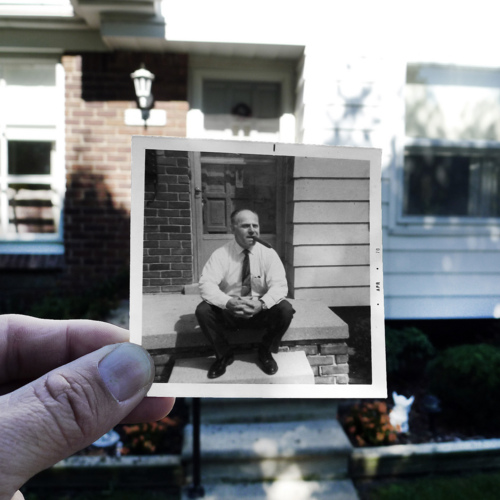
Dear Photograph Photo Blog: Seeing the Past in the Present


Photographs are a wonderful phenomenon; they allow you to see into the past while you're in the present. But what if you can combine the two? Taylor Jones' simple idea gave rise to Dear Photograph, the now popular photo blog which allows you to see old photographs set in the present.


The idea behind the blog is simple: take an old picture, go to the place where it was taken, line it up to against the frame of the location, and take another picture. You then get a picture of a picture, only this one carries a bit more weight with the now apparent passage of time.

Blog founder curator Taylor Jones stumbled onto the idea while browsing through an old family album. He found a picture of his younger brother, and saw that his brother was also in the room, giving him a weird sense of nostalgia. Jones got his camera, took the old photo, lined it up with the original location, snapped the picture, uploaded it, and within a few months his blog had gone viral.


The magic of the photographs within photographs is immediately obvious; viewers get to see how much has changed within the span of time, and those in the pictures get a priceless feeling of nostalgia.This after all is the purpose of taking pictures nowadays, to preserve a moment in time for all of eternity.

Here, the moment gains more meaning as people can see just how much the place has changed since taking the original picture. Sometimes, the place remains the same, only the people have grown up or passed away. The only certainty presented in these images is that once a moment in time has passed, it can never be recovered, only preserved and appreciated in pictures.


This is Taylor Jones' Dear Photograph photo blog. There's also a facebook fan page here. You can keep looking into the past with the upcoming Dear Photograph book to be released sometime next week.

Absolutes Rules of Photography: Unhelpful Tips for Beginner Photographers


Browsing through the entries of this blog, one might think that photography is all work and no play, something that is to be approached with absolute solemnity and only when one is mature enough to differentiate between aperture and ISO. Nothing could be further from the truth as all photographers started their passion for photographers breaking a few rules here and there. If you've just bought a camera, or you're just looking to refresh your memory, these "Useful advices for photographers" by Ivars Gravlejs might be exactly what you're looking for.

Ivars Gravlejs is a photographer and artist with numerous projects and accolades to his name, but it's his collection of photography rules for complete idiots that garnered him online attention. For two years, he slowly accumulated these tips, publishing in a weekly newspaper until he collected 78 in-your-face rules for photography. However, he takes these tongue-in-cheek lessons to the extreme to the point that they become a parody of the medium itself.

Here are a few more examples of his excellent anti-tutorial.


Check out more obvious tips for beginner photographers over at Ivars Gravlejs' website. Alternatively, all 78 parody rules can be found here.

The Reel Foto Blog 1st Year Anniversary and the 1st image on the Internet


A year ago this week, the Reel Foto Blog was born on an unassuming rant extolling the genius of Henri Cartier-Bresson. One year on, the blog continues to rant on the genius of photography itself. To celebrate this moment of firsts, here is a little bit of trivia: The above picture holds the distinction of being the first photographic image published on the Internet.

The image is that of CERN employees/pop group "Le Horribles Cernettes" nicknamed the LHC (a play on the initials of the Large Hadron Collider). The picture was uploaded in 1992 on the request of Tim Berners-Lee (the inventor of the World Wide Web). As LHC singer Silvano de Gennaro put it, "How was I to know that I was passing an historical milestone, as the one above was the first picture ever to be clicked on in a web browser!"

More information on "Les Horribles Cernettes" and the story behind the first picture on the internet over here and here.

The Sartorialist: A Visual Life


Some of you may remember my post on Scott Schuman's The Sartorialist blog a few weeks back. Well, Annette from Social Radius has asked me to share this short documentary video on the subject.


(If you're having trouble with the embedded video, you can watch it here: http://youtu.be/e5NgG5koPZU).

The seven-minute video, directed by Tyler Manson for Intel's Visual Life series, is an interesting and intimate look at how Mr. Schuman works on the streets looking for his next blog feature. There's really nothing fancy in what he does, save for the fact that he spends up to five hours everyday, just being in the world that he's in. As he puts it, it's like, "...going out there and letting yourself fall in love a little bit everyday..."

If you haven't seen my original post on Scott Schuman's Sartorialist blog yet, you can check it out here. Of course, don't forget to check out to check out The Sartorialist blog itself, you won't be disappointed. Finally, if you have anything that you would like to share with other readers here on the blog (be it a video, a picture, or a feature on a photographer) and you think that it's in keeping with the theme of the site, feel free to contact me or leave a comment below.

The Sartorialist by Scott Schuman


Some of the best fashion photography events happen not only in studios, but also out in the streets of the city. Through photographer Scott Schuman's lens, the dapper designs of ordinary people which would ordinarily go unnoticed are captured for posterity and presented on The Sartorialist blog.


The Sartorialist, which recently won LIFE.com's first annual Photo Blog Awards, stemmed out of Mr. Schuman's own experience in the fashion industry. He saw something missing between what he saw in the showrooms and the streets, and thought that he could try to bridge that gap. He started to carry a digital camera and documented the people out of the studio whom he thought would be inspirational to designers. He began the Sartorialist blog in 2005 to share his findings, and the results have been extraordinary.


Unlike other photography sites and fashion blogs, The Sartorialist doesn't just concentrate on the usual 20-40 year old demographic; all kinds of peoples, cultures and ages are represented. It's not just an apparel and accessories site either; the focus is always on the people and how they wear their clothes and not the other way around.


The photography style employed is quite simple; the subjects are presented in close-ups, three-quarters or full body attire. Some of them sit, some of them are on bikes, but most of them just stand naturally. Because of the nature of their settings, Mr. Schuman has to work fast with what he's presented. He only uses natural light and doesn't go out of his way to pose them in a particular way.


Mr. Schuman takes photographs in the streets of many cities, but most of the photos are taken in New York, Paris, Milan and Florence in between his visits to the fashion shows there. Although there is a universal feel to all of these portraits, each of these cities have their own individuality that you can start to see as you go through the blog.


The subjects and their clothing all make the photographs work. There is nothing special the Mr. Schuman does save for the fact that he spends hours on the streets patiently looking for those two or three shots that will make the blog. His passion for fashion clearly radiates in every post and it becomes clear that photography is only the medium through which his passion can be shared.


Over the years, The Sartorialist has become even more famous as one of the best fashion websites that's still active today. However, something must be said of the documentary quality that Mr. Schuman displays in his photographs. While most comments on his blog focus on the fashion that the subjects wear, years from now these images will be celebrated for preserving the culture of these cities through the photographic form. They are both objective and beautiful at the same time. The full-length photographs in particular are reminiscent of photographer August Saunder's typologies many decades ago.


These are just a fraction of the treasure trove of images accumulated from over five years of documentation by Mr. Schuman. You can find more of these excellent photographs over at The Sartorialist blog. If you want to go over the best photographs while you're away from your computer, Scot Schuman has also published The Sartorialist book.